AI in Knowledge Work: Why Good Time Tracking Matters More
by Alexander Huber
AI makes knowledge work faster, but often harder to reconstruct
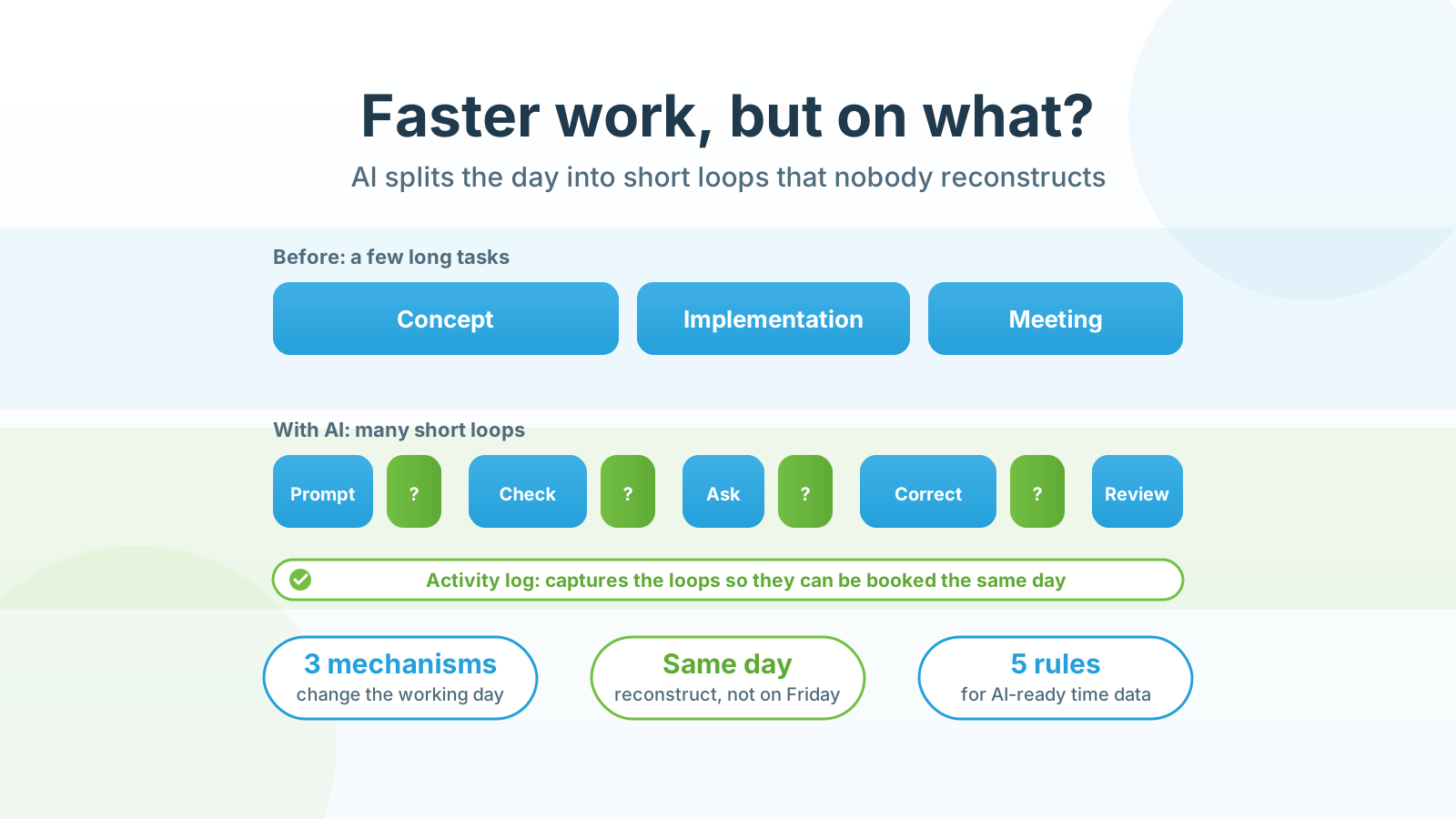
Anyone working in an IT services company today often switches every few minutes between code, emails, meetings, tickets, documentation, and project-related questions. Since tools such as Copilot, chatbots, and specialised assistants have become part of daily work, that pace has increased again. Many things move faster. At the same time, in our experience it often becomes harder at the end of the day to reconstruct cleanly what you actually worked on and for how long.
This is not a universal statement about every form of AI. However, across many teams we see the same pattern: AI reduces friction in individual tasks while working days also become more granular. When more intermediate steps run in parallel, more drafts are created, and more short digital interactions appear, the risk rises that working time is recorded incompletely, overload remains invisible, and project effort becomes distorted.
For IT service providers, this is not a side topic. If you work on a project basis, you need reliable time data for billing, utilisation, post-calculation, and working time transparency. In a working world shaped by AI, home office, and a high pace, good time tracking therefore becomes more important, not less.
What AI changes in knowledge work in practice
The debate around AI is often very abstract. In practice, we see something more concrete: work more often breaks down into many smaller units. A developer generates a code suggestion, reviews it, adjusts it, jumps into a ticket, answers a question in chat, joins a call, and documents decisions in a wiki at the same time. A project manager moves between customer emails, quote calculations, schedule coordination, and internal alignment, all within a short time window.
The problem is not that this work is unproductive. The problem is retrospection. The more strongly the day is shaped by many short digital traces, the more error-prone time tracking from memory becomes. That is exactly what we currently see in teams that integrate AI assistants broadly into day-to-day work.
There is also the risk of silent extra work. If someone quickly tests a prompt in the evening, double-checks a suggestion, or prepares a presentation with AI, it often feels like a small side task. Over weeks, however, that becomes real working time. Not because AI automatically leads to overtime, but because additional small work steps can easily happen outside visible planning. BAuA describes work-related extended availability as being available for work matters outside regular working hours and points in its literature review to predominantly negative effects on private life and health (BAuA).
Why this matters economically for IT service providers
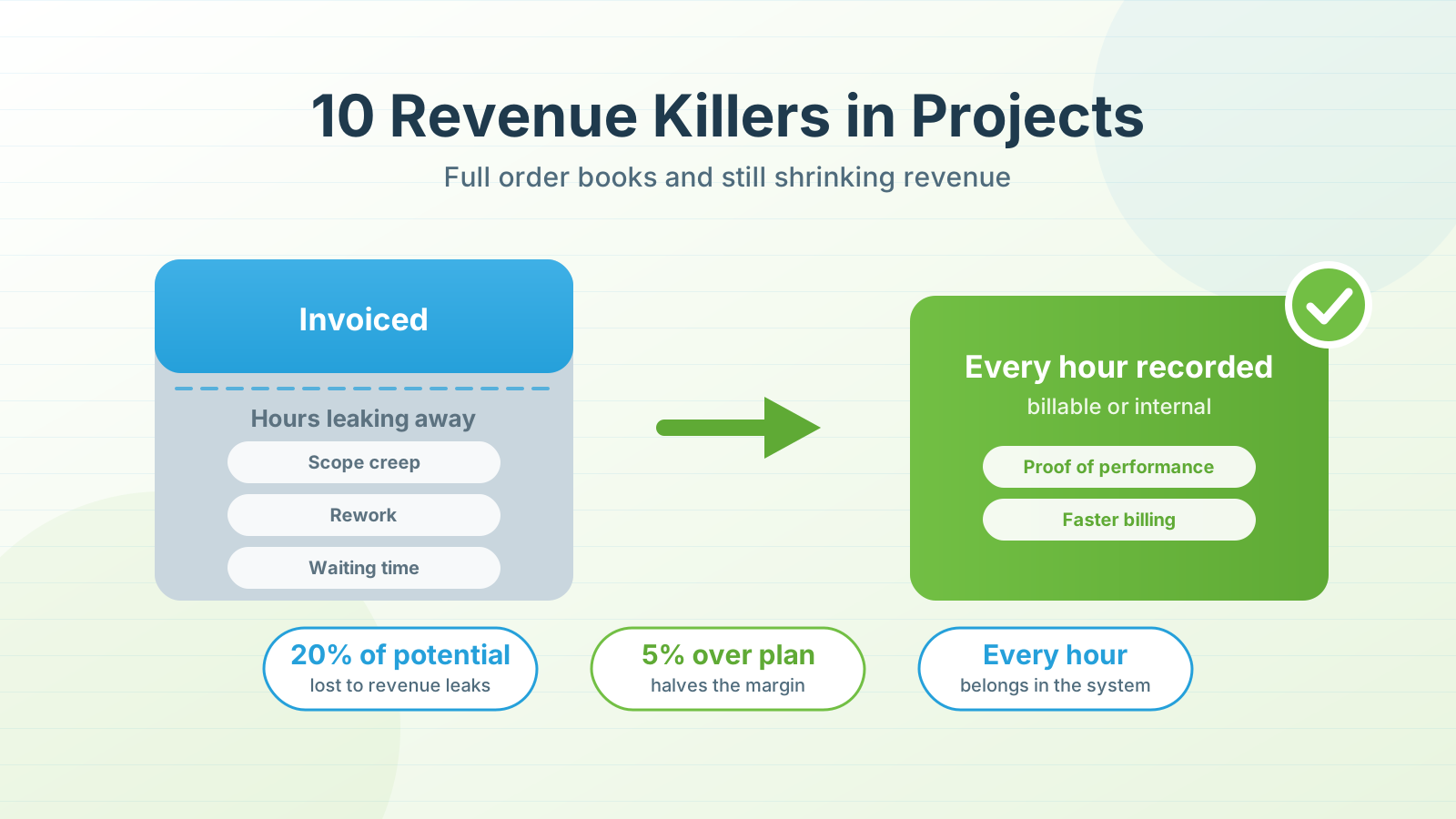
In service companies, many management questions depend directly on the quality of time data. If time is forgotten, entered too roughly afterwards, or distributed across projects in a blanket way, several problems arise at once:
- Project margins are assessed too optimistically or too pessimistically.
- Non-billable work remains invisible.
- Overload of individual employees is recognised too late.
- Quote calculations are based on misleading historical values.
- Discussions about overtime, compensation, and fairness become unnecessarily difficult.
AI does not intensify these issues because it is bad. It intensifies them because it makes the working day denser. More output in less time sounds positive at first. For controlling, however, it also means that the underlying work packages become more granular and therefore harder to capture retrospectively.
This is especially relevant in hybrid teams. In its current ESENER survey, EU-OSHA reports that the share of organisations with employees working from home has increased significantly. At the same time, 25 percent of organisations say psychosocial risks are still not being identified, and 43 percent now take digital technologies into account in their risk assessments (EU-OSHA). For management teams, that is an important signal: digital work needs more visibility, not less.
What studies and sources say about it
For companies, the most relevant issue is the combination of digital work, home office, and mental strain. In its current ESENER survey, EU-OSHA reports that the share of organisations with employees working from home has increased significantly. At the same time, 25 percent of organisations say psychosocial risks are still not being identified, and 43 percent now take digital technologies into account in their risk assessments (EU-OSHA). This is not proof that AI automatically leads to overload. However, it clearly shows that digital work has to be made organisationally visible if strain is not meant to remain under the radar.
Research around availability is also relevant. The literature review referenced by BAuA describes work-related extended availability as increasingly enabled by digital media and points predominantly to negative links with health and life domain balance (BAuA). For modern knowledge work, that means the boundary between productive flexibility and gradual boundary erosion needs to be actively managed.
In 2021, WHO and ILO also summarised that long working hours are associated globally with significant health consequences and referred to 745,000 deaths from stroke and ischemic heart disease in 2016 (WHO). That finding sits on a different level from the day-to-day reality of project teams. Still, it shows why working time is not just an administrative topic. As soon as extra work remains systematically invisible, companies lose an important basis for intervening early.
The practical connection to time tracking
This is exactly where time tracking becomes a management tool with a healthy sense of reality. Not as a tool of mistrust, but as a basis for transparency, fairness, and better project steering.
In many conversations, we currently hear essentially the same sentence: “I was busy all day, but by the evening I can hardly put together completely what I actually did.” Situations like that do not require rigid time clock logic. They require support in remembering and classifying work.
time cockpit describes its Activity Tracker exactly in this sense: as a digital assistant that documents activities automatically and helps people keep an overview of their working day (time cockpit). The recorded information becomes visible in the graphical calendar and serves as a basis for reconstructing bookings more accurately, not for evaluating people automatically. When work becomes more granular and more dependent on memory, the value of a good and ideally unobtrusive memory aid increases. time cockpit describes its Activity Tracker exactly in this sense: as a digital assistant that documents activities automatically and helps people keep an overview of their working day (time cockpit). The recorded information becomes visible in the graphical calendar and serves as a basis for reconstructing bookings more accurately, not for evaluating people automatically.
That matters especially in knowledge-intensive work. When a day consists of many small steps, a memory aid often makes the difference between clean project time tracking and a blanket catch-up entry on Friday evening. More about the practical implementation can be found on the Activity Tracking page.
Why this also fits culturally with New Work
Many teams fear that more transparency automatically means less trust. Our experience is different. The key is to separate transparency about work from control of people. Modern knowledge work needs autonomy, but it also needs a reliable framework. Especially with flexible working hours and home office, trust becomes stronger when expectations, time, and workload remain understandable.
This also fits the broader debate around flexible working models. In the article Trust-Based Working Time and Time Tracking, we describe why trust and transparency are not opposites, but often reinforce each other in practice.
From our perspective, New Work does not mean giving up data. New Work means giving people more ownership while also providing tools that let them document their working day cleanly without additional bureaucracy.
Tips from our practice with time cockpit
If you already use AI tools broadly across the company or are preparing their rollout, five things have proven useful from our perspective:
Record time as close as possible to the actual working day. Short reconstruction on the same day is far more reliable than broad catch-up entries at the end of the week or month.
Make context switching visible. Especially in IT projects, many small but relevant tasks arise around coordination, research, review, and documentation.
Separate memory support and control clearly. An activity log should support employees in booking cleanly. It should not be introduced as part of a surveillance narrative.
Do not look only at billable hours. AI also changes internal work, for example knowledge building, quality assurance, proposal work, or process improvement. These hours are economically relevant even if they are not billed directly.
Use time data for prevention, not only for billing. If evening work, very frequent context switching, or strong weekly fluctuations become visible on a regular basis, that is a management signal. Our article about introducing a time tracking system shows why clear rules and good communication matter so much here.
Conclusion
AI makes knowledge work more capable. At the same time, in many teams it becomes harder to remember working days completely and document them fairly. For IT service providers, that is a good reason to rethink time tracking, not as a compliance exercise, but as a prerequisite for sound project steering, fair working time transparency, and better overload prevention.
The central management question is therefore not whether AI and time tracking fit together. The more important question is how time tracking can be designed in an AI-shaped working world so that it makes everyday work easier instead of creating additional friction. That is exactly where we see the opportunity for modern, supportive solutions: less reconstruction based on gut feeling, more reliable visibility into projects, working days, and actual workload.