Time Tracking for External Staff: What to Consider
by Alexander Huber
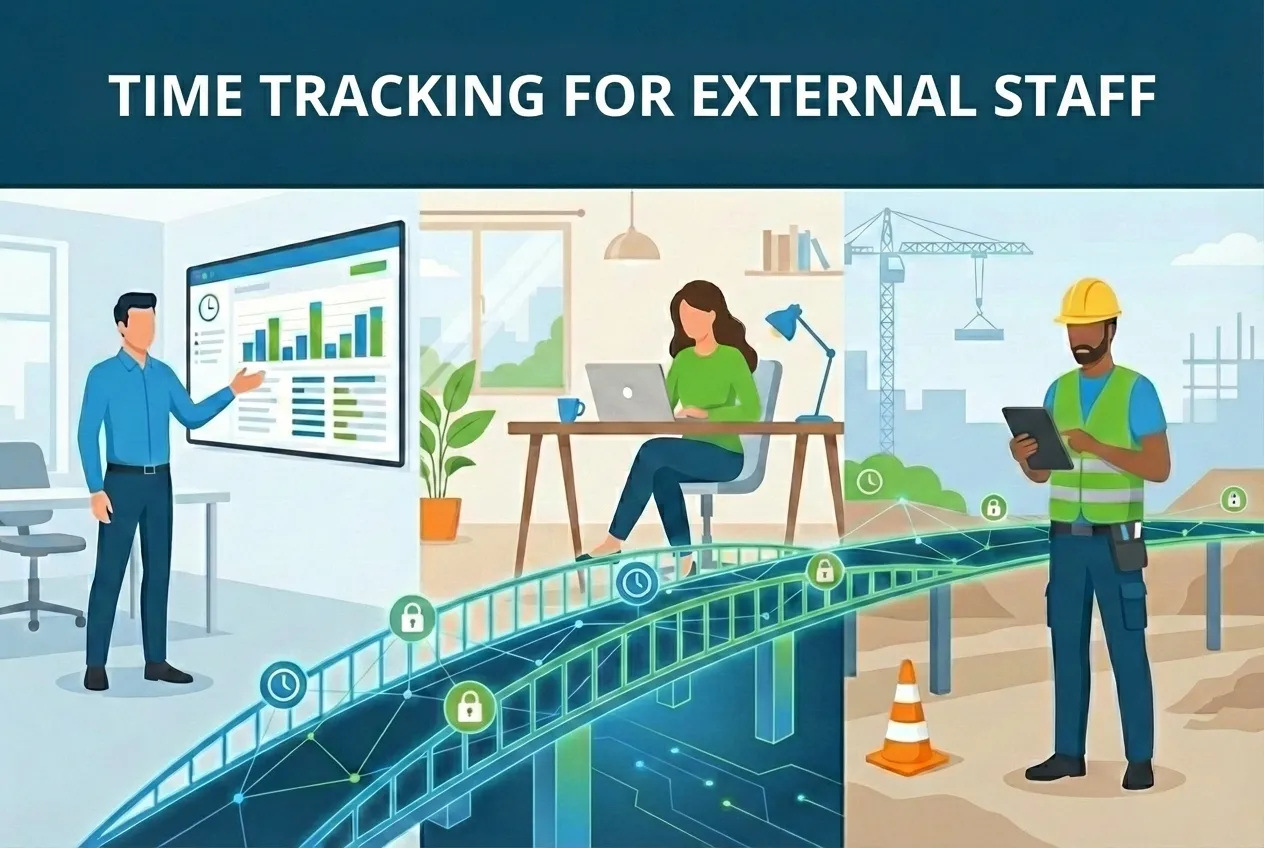
Mixed teams of internal and external professionals are normal today, and they make time tracking more complex than many expect. Different contract models, privacy requirements, billing logic, and compliance duties collide. At the same time, clients expect transparency, billing certainty, and understandable project time tracking. The question is how to support mixed teams in a flexible and economical way, without rigid license models and without exposing internal data.
Why time tracking for external staff is more complex than it seems
External staff often work under a statement of work (result based), as freelancers (self employed, project based), or via staff augmentation or agency models (assignment and time based). That creates different requirements: Who is allowed to see what? How do you prove delivered work? How do you keep budgets controllable?
One size fits all processes fail here. What you need are flexible workflows with clear role logic that keep project time tracking at the center (instead of purely recording attendance).
In practice, with external staff it is usually less about whether someone was “present” from 9 to 5, and more about which part of the project was actually delivered and whether it is billable. For billing and project controlling, you need a reliable assignment (client, project, activity) so that services are traceable, change requests can be justified, and plan vs actual comparisons work. Pure attendance tracking (for example, a clock in system) does not help much because it does not show deliverables or budget consumption.
Note: This article is not legal advice. All information has been researched carefully, but it cannot replace individual legal counsel. For concrete labor law questions, talk to your legal team or a qualified law firm.
Legal basics
It is crucial to clearly differentiate the contract model: statement of work, freelancer, staff augmentation, and what that means for time tracking. In many setups, documentation is required by contract (proof of service, acceptance, milestone billing, or hourly billing). With staff augmentation models, strict documentation duties are common; with freelancers and statements of work, time tracking is often the basis for billing and evidence.
In addition, you need to respect working time rules where applicable and privacy requirements (data minimization and purpose limitation).
Privacy note: For time tracking, organizations should follow the principle of data minimization: only collect personal data that is truly required for billing, project steering, or documentation duties (Art. 5(1)(c) GDPR, “data minimization”: data must be “adequate, relevant and limited to what is necessary”). At the same time, the principle of purpose limitation applies: time data should only be processed for the defined purpose (for example, proof of service, billing, controlling) and not in a way that is incompatible with that purpose (Art. 5(1)(b) GDPR, “purpose limitation”). (Art. 5 GDPR, GDPR Info)
Legal classification: employee vs freelancer or statement of work
When working with external staff, what matters is which contract model actually applies and how it is lived day to day.
In Austria, the Austrian Federal Economic Chamber (WKO) differentiates between an employment contract, a free service contract, and a statement of work. Free service providers are typically not personally bound by instructions, can determine working time and place largely on their own, and are not integrated into the company’s organization like employees. Statement of work contractors, in contrast, owe a concrete result and deliver it independently. That also implies: not every external engagement automatically creates the same working time obligations as for employees. (WKO: Freier Dienstvertrag, labor law)
Austria’s Chamber of Labour also emphasizes that free service contracts are not the same as classic employment relationships, and that labor protections apply differently depending on the specific setup. (Chamber of Labour: Freier Dienstvertrag)
In Germany, a similar principle applies: the Working Time Act (Arbeitszeitgesetz, ArbZG) is aimed at employees, not truly self employed people (see § 2 ArbZG at https://www.gesetze-im-internet.de/arbzg/). For organizations, the risk is therefore less “working time law for freelancers”, and more misclassification. If an external person is actually integrated into the organization and works under instructions like an employee, this can be treated as dependent employment, with consequences (including working time rules, social insurance, and back payments). To clarify status, the status determination procedure by Deutsche Rentenversicherung Bund can be used.
False self employment: a short overview (AT and DE)
False self employment means someone appears as a self employed contractor on paper, but in reality works like a dependent employee and shows key characteristics of employment. This can trigger labor, social insurance, and tax consequences for both the client and the contractor, including back payments and reclassification.
In Austria (AT), false self employment is typically assessed in the context of social insurance classification and the differentiation between free service contracts and statements of work. The decisive factor is not the label of the contract, but how the work is actually performed. If a supposed contractor works in personal, time, or organizational dependency, it can be reinterpreted as an employment relationship in specific cases. See the WKO guidance on the topic. (WKO)
In Germany (DE), the concept is similar. Deutsche Rentenversicherung explains that such work can be classified as dependent employment for social insurance purposes, and that the client can be liable for contributions if false self employment is found. (Deutsche Rentenversicherung)
Signals that often point to false self employment (DE and AT):
- Long term dependency on a single client.
- Being subject to instructions regarding time, place, or how the work is performed.
- Integration into internal processes (for example, fixed schedules, mandatory internal tools).
- No meaningful own equipment or entrepreneurial risk.
If several of these criteria apply, you should consider a careful review, and possibly a formal status determination procedure (for example with Deutsche Rentenversicherung in Germany).
Typical pitfalls in mixed teams
We regularly hear the following statements in projects with internal and external staff. They often come from good intentions or time pressure, sound reasonable at first, and then turn into a permanent source of friction. Suddenly procurement, project management, and controlling discuss the same topic, but with different goals. External colleagues lose time because expectations and processes are unclear.
The problem is rarely time tracking itself. It is the combination of missing project context, inconsistent rules, and overly broad access rights. Then you lack reliable proofs of service, scope changes are hard to justify, and access often stays active longer than planned during offboarding. The overview below translates typical day to day statements into concrete measures that work well in practice and make collaboration noticeably calmer.
| Typical statement | What helps in practice |
|---|---|
| “External staff must not see the system.” | True if “the system” reveals everything. With fine tuned permissions, externals see only what they need. |
| “External staff are temporary, a license is not worth it.” | Licensing must be flexible. Ideally you only pay for active usage. |
| “We bill by deliverables, why track time at all?” | Without activity and project context, you lack evidence for scope changes, change requests, and post calculation. |
| “Just email me your hours.” | Distributed, error prone, not audit ready. Better use standardized templates or a secure import process. |
| “External means black box.” | Project context (project, activity, effort type) makes work traceable for billing, controlling, and quality. |
Once you name these pitfalls clearly, many things become simpler: you do not need special rules per person, you need a standard that works for all external roles. In practice, that means a clean onboarding process, clear permissions, a clear assignment to project and activity, and a reliable way to bring proofs of service into controlling. From here, it pays to solve identity and access first, because that is where most security and offboarding problems arise.
SSO and identity management: onboard externals to the same standards
Another practical lesson: the “same standards for externals” problem is rarely the time tracking tool itself. It is often the identity and permission process behind it. If externals get logins outside your IT governance, things quickly become messy. Passwords get shared, offboarding gets forgotten, and no one is sure who still has access.
That is why we aim to implement single sign on (SSO) and a clean role model as early as possible. With time cockpit, you can integrate your identity provider, for example Azure Active Directory or Okta, so the same policies apply as for internal staff (for example MFA, conditional access, central deactivation) (Enterprise features). Automated user management via the Integration and Web API also allows HR systems to provision and deprovision external accounts automatically. This is not only more secure, it also reduces operational effort because onboarding and offboarding no longer need to be duplicated across multiple systems.
Most important: external staff should have their own personal accounts (no shared project logins). Combined with a finely granular permission model and clear project rights, externals can book productively without seeing internal data they should not see.
How time cockpit addresses these challenges
In our projects with mixed teams, one pattern shows up again and again: the key is not whether externals can enter time at all, but whether it stays simple, secure, and billable for everyone involved. That is why we combine flexible usage, clear permissions, and solid identity management with a process that puts every booking into the right project context. The building blocks below remove the most common sources of friction while enforcing the standards you already expect internally.
| Building block | Practical impact |
|---|---|
| Pay per use instead of rigid licensing | Billing only for active users, pay per use per user and the days they are enabled. No minimum term, no bundles, no cost for inactive accounts. External access can be disabled after project completion while time data and proofs of service remain complete and audit ready. |
| Configurable permissions Privacy by design | Thanks to the customizability of time cockpit, access for externals can be tailored precisely to their engagement. Externals see only what they are allowed to see, for example only their own bookings, specific projects, or defined activity catalogs, without visibility into internal rates, team reports, or confidential documents. We support you in configuring these settings correctly. |
| Standardized Excel imports for teams without direct access | If an external provider should not get direct access, processes can still stay clean. Time data is submitted via defined Excel templates or CSV and imported centrally, including plausibility rules, project and task context, and approvals. For this purpose, time cockpit provides a feature rich Excel importer. |
| Project time tracking with context instead of pure attendance | Every booking is linked to project, activity, and effort type (billable or non billable). That makes services transparent, increases billing certainty, and creates the foundation for post calculation, forecasting, and project controlling. |
Once these building blocks are in place, time tracking becomes a repeatable process rather than a case by case debate. Next, it is worth capturing the rules as short and understandable guardrails, so internal roles, external roles, and project leadership do not need to renegotiate them every time.
Best practices for mixed teams at a glance
- Clarify upfront: What is tracked and how (activities, effort types), who approves, and which deadlines apply?
- Use consistent templates and structures per project: fewer follow up questions, better data quality.
- Protect privacy: only the necessary visibility, and careful use of person level reports.
- Handover and closure: clean data handover, closure report with KPIs (for example utilization, plan vs actual variance).
- Standardize onboarding and offboarding: use SSO, personal accounts, and revoke access immediately when the project ends.
Practical implementation: from contract to billable hour
Before external staff can book productively, you need a lean and robust flow. Define a shared activity catalog and project or task structure so that services become comparable and billable. If a provider should not get system access, set up standardized Excel or CSV templates, including plausibility rules and approval steps, and import centrally.
Onboarding means creating an account (or handing out the template), assigning projects, and clarifying deadlines and approvals. In operations, reminders and clear responsibilities protect data quality. Controlling checks utilization, plan vs actual variances, and budget consumption on a sample basis. During offboarding, external accounts are disabled, while proofs of service remain audit ready in the system, for billing, audits, and post calculation.
Conclusion
External staff are not a special case, they are a core part of modern project delivery. The key is that time tracking does not become a hurdle, but an evidence chain: understandable for procurement and HR, controllable for project leads, compliant for governance, and fair for those delivering the work.
With a flexible pricing model you avoid rigid licensing. With finely granular permissions you protect confidential information. With Excel imports you can connect teams without system access. And with consistent project context, hours become reliable numbers for billing, forecasting, and post calculation. This reduces day to day friction while increasing transparency and controllability, from the first briefing to the closing report. In short: if you map external work with a clear process and the right tool, you reduce debate and increase evidence, keep budgets under control, and gain planning certainty across the entire portfolio.
Related reading:
- Why Project Time Tracking Delivers More than a Time Clock — why project context matters more than attendance recording for mixed-team delivery
- Employee vs. Project Time Tracking: One system or separate? — how to decide whether to run one integrated system or separate tools for internal and external staff