Time Tracking for Startups and Small Businesses
by Alexander Huber
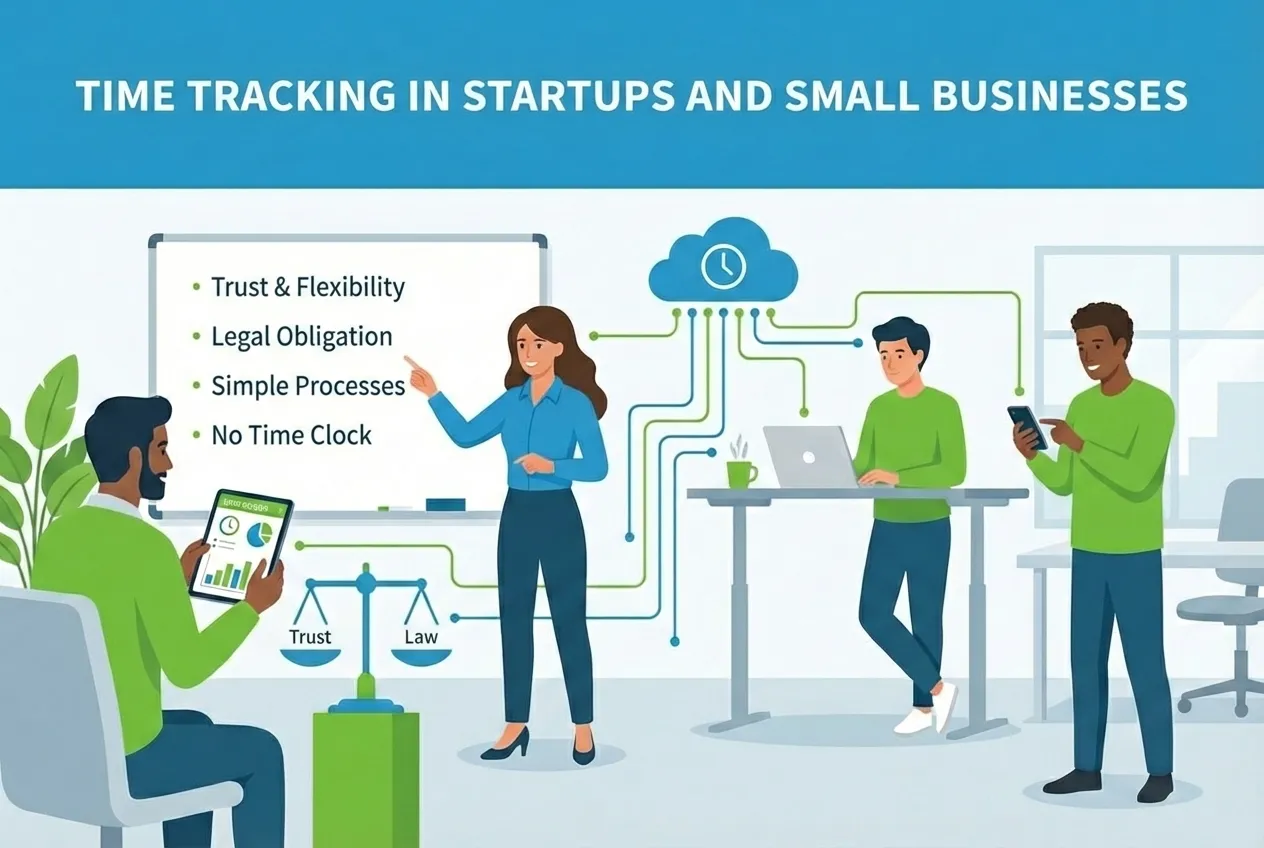
“We are a small business. We do not need time tracking.”
We hear this sentence not only in startups, but also in small businesses with ten, twenty, or thirty employees. Trust over control, flexible working hours, results over punch clocks, culturally that often fits well and is usually meant honestly.
This reflects what we have seen over the last 15 years: how do you stay fast, flexible, and pragmatic, and still build processes that hold up legally and do not annoy people in daily work. This article is written from exactly that practical experience.
The problem is less cultural and more legal. Working time recording is no longer a voluntary organisational choice, it is a legal obligation. And this obligation applies to startups and small businesses just as much as to large corporations.
The legal reality: time tracking is already required
The turning point came in 2019 with a ruling by the European Court of Justice. The court clarified that employers must introduce an objective, reliable, and accessible system for recording daily working time. The goal is to protect employees from unpaid overtime and health risks caused by overload. (PwC)
What matters: it is not only about overtime. Employers must record the start, end, and duration of daily working time. The ruling does not provide an exception for small businesses or startups.
Germany: mandatory with no transition period
In Germany, there was a long debate about whether and when the ECJ ruling had to be implemented in practice. That debate ended at the latest with the German Federal Labour Court decision from 2022. The court stated that employers are already required to record working time systematically, even without a new law. (Bundesarbeitsgericht)
Germany’s Federal Institute for Occupational Safety and Health confirms this interpretation explicitly and points out that the obligation to record working time already follows from existing occupational health and safety law. (BAuA)
A future law will mainly define how time tracking must be implemented technically, not whether it is required. For companies, that means: waiting does not create legal certainty.
Austria: obligations in detail
Austria also has clear documentation obligations for working hours, especially in connection with overtime and rest periods. The legal framework is based, among other things, on the Working Time Act (AZG).
ℹ️ Reading tip: Detailed requirements (including section 26 AZG) and typical practical questions are summarised here: Working time recording obligations in Austria.
Why startups and small businesses are particularly exposed
Many teams assume that their size or their modern work culture effectively exempts them from the obligation to track working time. The opposite is true. Startups and small businesses often work without clear processes, without a dedicated HR function, and with a strong focus on flexible working time models, remote work, and personal responsibility.
From a legal perspective, however, the following applies: the less formalised the organisation of work is, the more important clean documentation becomes. Without reliable time records, the employer almost always carries the burden of proof in a dispute.
In Austria, compliance with working time regulations is not just an organisational question, it is legally relevant. The Working Time Act (AZG) contains penalty provisions. Employers who violate working time rules or documentation and retention duties can be fined by the district administrative authority (section 28 AZG). Source (RIS, section 28 AZG)
For managing directors of an LLC (GmbH), corporate law also comes into play. Under section 25 GmbHG (AT), managing directors must apply the care of a prudent businessperson. In practice, this includes ensuring organisational measures that support compliance with mandatory laws such as working time regulations. Source (RIS, section 25 GmbHG AT)
In practical terms: violations of working time rules and documentation obligations can have administrative penalty consequences for the employer (section 28 AZG). If poor organisation or oversight by management contributes to this, it can also raise civil liability questions under section 25 GmbHG (AT).
This hits small businesses particularly often because many factors come together:
- There are many part time arrangements, short term exceptions, and spontaneous assignments.
- Leadership happens close to daily operations, decisions are made quickly.
- Documentation is perceived as extra work, not as protection.
- Growth happens in jumps, for example when new customers come in.
The underestimated risks of missing time records
Missing or incomplete time tracking is not a purely theoretical risk. It can lead to labour law disputes, for example about overtime claims or terminations. It can also lead to findings in audits by authorities or social security institutions.
ℹ️ Further reading: The article The three biggest risks without time tracking summarises the risks in a compact and practical way. It shows why missing time records often lead to overload, blurred boundaries, and avoidable legal and organisational risks.
What is especially critical: working time protection is part of occupational health and safety. That means responsibility is attributed directly to management. Violations can be not only financially relevant, but also personally relevant, a risk that many founders and small employers simply do not have on their radar.
At the latest in investor conversations, due diligence processes, or larger customer projects, people will regularly ask how legally compliant working time recording is ensured. A vague answer or Excel lists based on gut feeling do not look professional here.
A similar pressure exists in funded projects. Many startups work with grants, including EU funding, or in research projects. In these settings, documentation and evidence requirements are often strict. Without clean, traceable time data, it becomes tedious or risky to prove project progress and proper use of funds.
Why Excel, paper notes, and gut feeling are not enough
In many small businesses there is a kind of “informal time tracking”: Excel sheets, weekly lists, or manual backfills. These methods may be well intentioned, but they fail to meet key requirements. They are neither consistent nor easy to explain reliably in an audit.
Legally compliant working time recording requires traceability, completeness, and transparency. In practice, this is realistically achievable only with digital systems, especially when working hours are flexible, distributed, or project based.
If Excel is still used for time tracking, this article provides guidance: 10 reasons not to use Excel for project time tracking.
Time tracking as basic company hygiene, not as control
When implemented correctly, time tracking is not an instrument of distrust, but a form of basic company hygiene. It protects employees from overload, creates clarity for managers, and forms the foundation for realistic planning and sustainable growth.
Modern digital solutions enable time tracking that integrates into daily work without damaging culture or autonomy. They make visible what is happening anyway, and that is exactly where the value lies.
For this to work in a startup, time tracking must also be accepted. Based on our practice, and aligned with the ideas from How to motivate employees to track their time, four things have proven particularly effective:
- Make the purpose crystal clear (occupational safety, fairness, planning), not “because we have to”.
- Start as simply as possible so it does not become bureaucracy.
- Combine trust and transparency, document without micromanagement.
- Take feedback seriously and show that time data is actually used.
Especially in dynamic teams with fast role changes, new colleagues, freelancers, or agencies, a lean routine helps as well. When onboarding and offboarding happen quickly, consistent categories, clear responsibilities, and simple rules matter more than perfect detail depth.
One key point for small teams is communication: time tracking means documentation, not control. This also fits well with: Trust based working time and time tracking.
Conclusion: the obligation exists, the decision is about how
For startups and small businesses in Austria and Germany, recording working time is legally mandatory, operationally necessary, and strategically sensible. It not only supports compliance with working time and occupational safety rules, but also provides the basis for reliable planning, fair compensation mechanisms (for example for overtime), and solid evidence for authorities, funding bodies, or due diligence situations.
The key question is therefore no longer whether you must record time, but how professionally and future proof you implement it. In practice, this means: records must be complete, traceable, and sustainably usable in daily work, without creating unnecessary friction. The earlier you establish a lean digital solution with clear rules and responsibilities, the easier it becomes to support growth in a legally sound and operationally clean way.
ℹ️ If you want to start with a free or low-cost solution, see An Overview of the New time cockpit Pricing Model — including a free year for freelancers and a flat-fee option for small teams. Current pricing is also on the pricing page.