Trust-Based Working Time and Time Tracking
by Alexander Huber
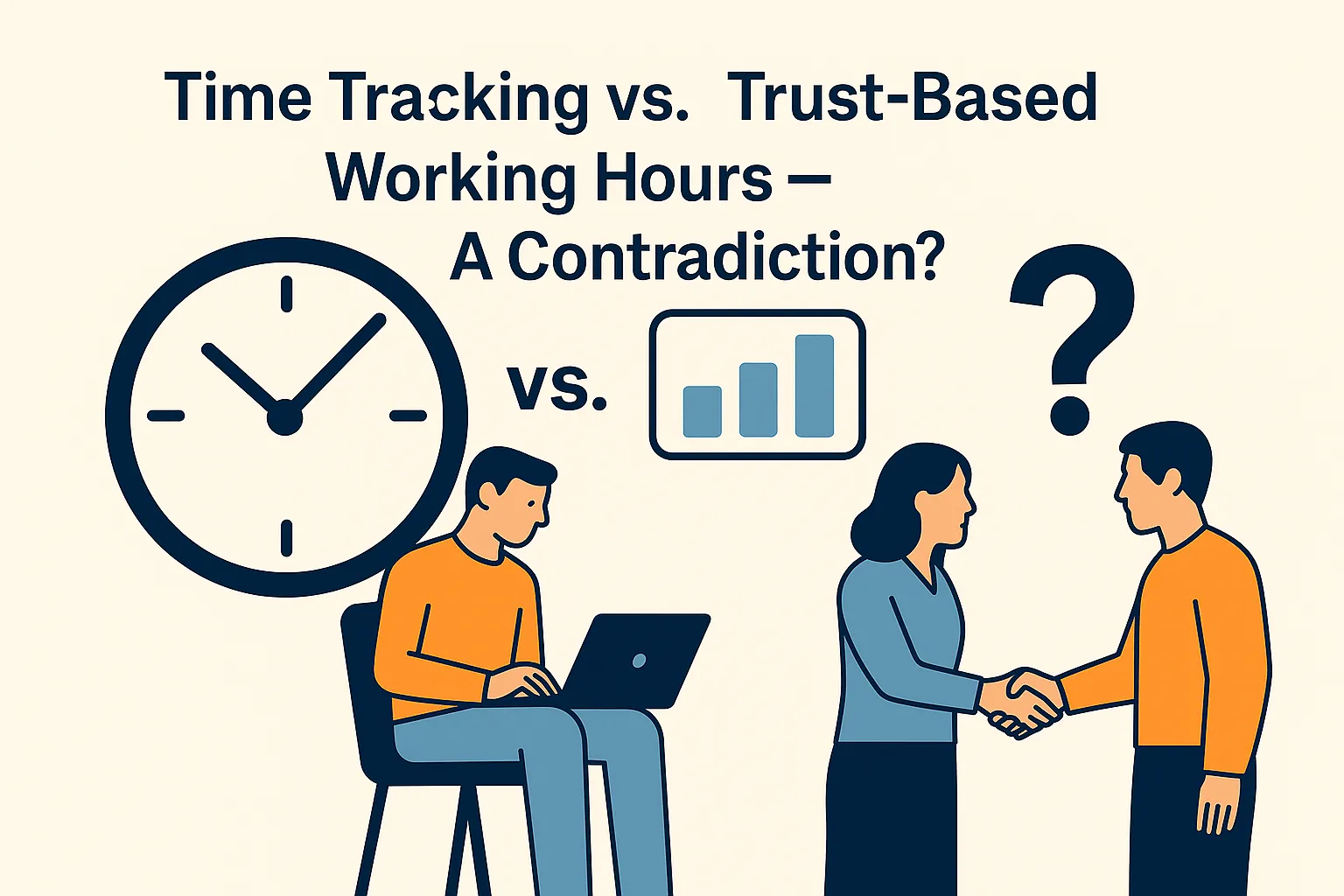
Many companies believe: if you trust your teams, you do not need to track working hours. At first glance, this seems logical. After all, trust-based working time stands for flexibility, autonomy, and results-oriented work. But since the rulings of the ECJ and the German Federal Labour Court (BAG), it is clear that working hours must be recorded—regardless of the model. The myth that time tracking equals control is persistent. See the ECJ ruling (C-55/18) CURIA judgement text and the BAG decision 1 ABR 22/21.
From our experience implementing time tracking in service organisations, we know: trust and transparency are not opposites. In fact, they reinforce each other.
In practice, a different picture emerges: modern time tracking can even strengthen trust. It becomes not a tool of control, but a foundation for fairness, overload prevention, and legal certainty (“Trust is good, recording is better. Working hours and time tracking in the home office”). Many organisations therefore face the same question: How can trust-based working time coexist with legally compliant time tracking?
This is where the real challenge begins. And the answer is: not only is it possible, it is necessary. The question is not if, but how.
Note: This article does not constitute legal advice. All information has been carefully researched but does not replace individual legal consultation. For specific labour law questions, please contact your legal department, the Chamber of Commerce, or a qualified law firm.
1. Myth vs. Reality – what companies often get wrong
The statement “We use trust-based working time, so we don’t need time tracking” is one we hear frequently from HR teams. In a modern context, however, trust does not mean that nobody documents when and how long they worked.
ℹ️ Trust means: no control of presence, no rigid schedules, no monitoring of start and end times.
But since the ECJ ruling on working time from 2019 and the BAG interpretation from 2022, companies must document working hours objectively, reliably, and in an accessible way. This applies equally to flexible models, remote work, and hybrid teams. This legal reality does not eliminate trust-based working time—it simply redefines it.
The debate also shows how important a shared understanding of “trust” is. In today’s working world, trust does not mean the absence of rules, but autonomy within a reliable framework—as emphasised by the European Court of Justice (Curia).
👉 The question is not whether time is recorded, but how flexible the working time model can remain.
2. What trust-based working time really means
Many companies use the term without having a consistent definition. Generally speaking, it describes a model in which the employer does not control daily working hours. The outcome counts, not physical presence. Employees decide freely when to start, take breaks, or structure their day.
⚠️ However, trust-based working time does not mean that legal requirements cease to apply. Rest periods, breaks, maximum working hours—all of these remain in force. This applies both in Germany (under the Working Hours Act) and in Austria (under the Working Time Act), meaning that working time documentation in Austria is just as mandatory as in Germany.
Courts have made this clear: documentation is compulsory, regardless of culture or model.
Tip: Trust-based working time is a cultural principle—not a legal substitute for time tracking.
3. Compatibility with ECJ and BAG: why both models belong together
The ECJ ruling of 2019 (“time clock ruling”) explicitly states that employers are required to track working hours. The BAG decision of 2022 follows the same logic: companies must provide a system that enables systematic recording.
Many managers therefore fear trust-based working time is no longer feasible. But this assumption is incorrect. The courts do not interfere with corporate culture—they simply require working hours to be recorded transparently.
The key point: trust means not controlling how or when work is performed. Time tracking means documenting what was worked, in a legally compliant way. Both can coexist.
We see with our customers that transparent recording not only helps legally but is also a powerful lever for better team leadership—e.g. identifying burnout risks early.
Tip: Clearly communicate that time tracking is legally required but not a control mechanism.
4. Advantages & challenges of trust-based working time
Trust-based working time creates freedom: flexible work, less micromanagement, individual time planning. This boosts motivation and employer attractiveness. At the same time, it introduces new risks—often underestimated.
Key advantages include autonomy, higher satisfaction, and the ability to use performance peaks effectively. On the other side, challenges such as potential overload, invisible overtime, or blurred boundaries between work and personal life can emerge.
Without transparent working time tracking, there is a risk that nobody notices when employees consistently work too much. Here, transparency protects employees—not the employer.
Studies show that employees in trust-based models often work more than legally allowed, especially in hybrid or remote settings (BAuA).
Tip: Highlight that documentation also prevents self-exploitation.
5. Why the classic time clock is outdated
The traditional time clock comes from a world where working time meant physical presence. Today, teams work hybrid, remote, and project-based. Presence says little about performance. For many models, clocking in and out is impractical and symbolically negative.
Instead, modern systems should rely on context—such as project context, focus time, or the ability to record retrospectively.
An alternative to the classic time clock is the Activity Tracker in time cockpit. Unlike traditional time clocks, it captures digital work activities automatically and locally—without monitoring presence, but with a focus on context and user autonomy.
→ How Activity Tracking works in time cockpit
Tip: Replace the mental image of a time clock with one of modern data collection.
6. How time tracking and trust-based working time can be combined
Many companies quickly realise there is no contradiction. Employees retain full autonomy over when they work. Recording serves transparency—not surveillance. It supports legal compliance, fair workload distribution, and overload prevention. Leadership teams can identify patterns that remain invisible without data, such as recurring workload peaks or silently accumulating overtime. Transparency enables better decisions without limiting freedom.
💡 Especially in project-based organisations, we have seen that clean project time tracking helps teams make strategic, data-driven decisions, such as capacity planning or staffing.
→ Key performance indicators in project time tracking
A modern model for autonomous time tracking also strengthens fairness: everyone works flexibly, and everyone shares the same basis for fair workload distribution.
Tip: Communicate clearly why tracking working hours is not an intrusion on autonomy.
7. Technology that strengthens trust
Time cockpit does not rely on rigid presence logic but on flexible recording concepts. Especially relevant for trust-based working time: Activity Tracking. It recognises which digital activities were performed—without surveillance, locally on the device, and only visible to the user. This makes retrospective recording easier and reduces mental load or unnecessary context switching. Beyond that, time cockpit adapts to models such as flexitime, project time, or trust-based working time.
This flexibility helps companies shape processes without changing their culture.
At time cockpit, we see that especially smaller organisations benefit from this flexibility because they rarely need a “one size fits all” solution. → Customisable time tracking in time cockpit
Tip: Choose systems that support culture rather than dictate rules.
⚠️ Trust-based working time and bonuses – an example from the Austrian IT Collective Agreement
Trust-based working time sounds like maximum flexibility, but here lies a legal pitfall:
Under the Austrian IT Collective Agreement (IT-KV), working hours before 06:00 and after 20:00 require premium pay. This applies regardless of whether employees choose to work at those times voluntarily. Concretely:
- For activities outside the 06:00–20:00 window, premiums or overtime pay apply.
- Even with trust-based working time, these rules remain binding. The employer must be able to document when work was performed.
This puts companies in a difficult position: without reliable time tracking, it is nearly impossible to calculate premiums correctly. And even if employees organise their time freely—e.g., in home office or asynchronous project work—the company remains legally responsible.
💡 Anyone who wants to enable trust-based working time needs legally compliant time tracking that records working hours precisely—not only for compliance, but also to avoid back payments or labour law risks.
Source: IT-KV 2025, § 4 Abs. 1
Conclusion: No contradiction, but a modern working model
Trust-based working time and time tracking are not opposites. On the contrary—they complement each other. Transparency protects employees, ensures legal certainty, and helps organisations distribute workloads fairly. Modern tools enable flexible recording without falling back into outdated control patterns.
Time tracking is not just a legal requirement—it can also be a strategic advantage: in recruiting (“We work transparently”) or in customer communication (“We show exactly how time is used”).
ℹ️ Further reading: What happens concretely when organisations skip time tracking is covered in The Three Biggest Risks of Not Tracking Working Hours.
👉 Think of trust-based working time not as the opposite of time tracking, but as a cultural principle supported by a clear structure.