IMC: Project time tracking at an IT system house with time cockpit
Everything we used to do in Excel or with some other software product now runs professionally in time cockpit. That gives me a lot of freedom as an entrepreneur: it simply works, and we have things under control.
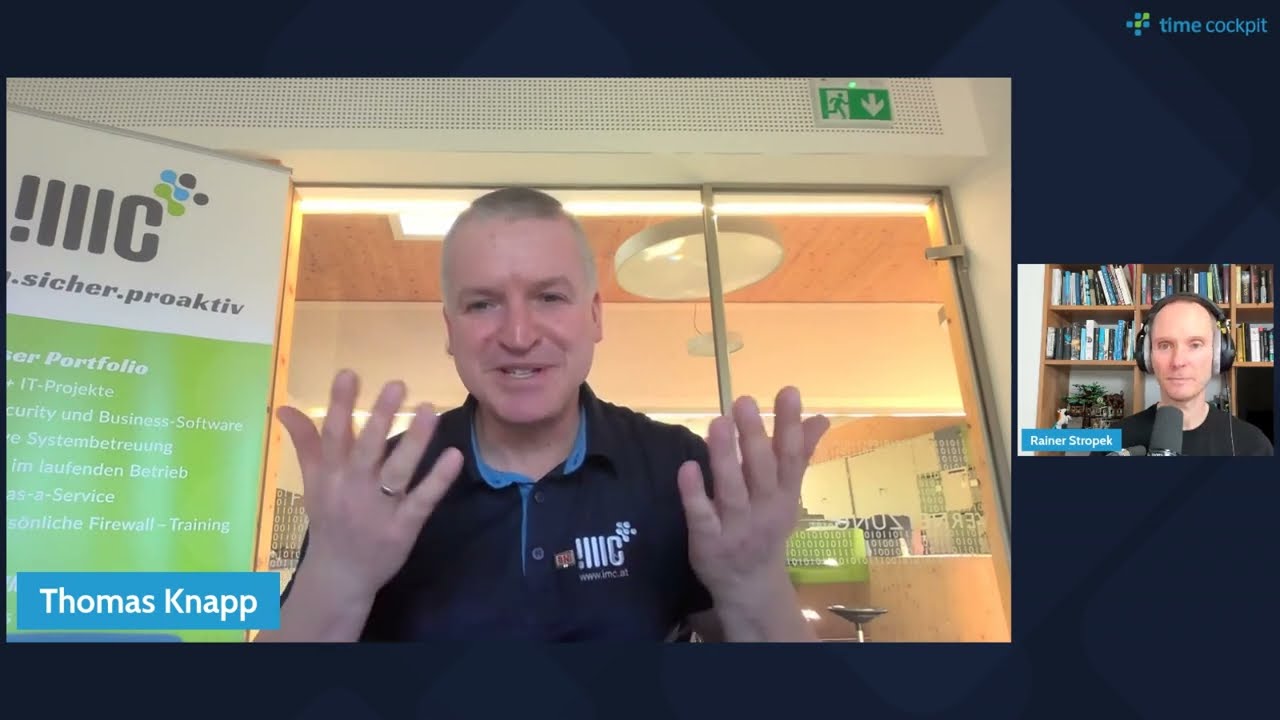
At a glance
| Company | IMC IT Management und Coaching GmbH, IT system house in the Ybbstal business park, Lower Austria, in business for more than 20 years |
|---|---|
| Team | 14 people at one location; technicians spend much of their time on site at customers |
| Starting point | Working time rules and invoicing handled in Excel and an earlier time tracking product, paper-heavy invoicing process |
| Solution | time cockpit as software as a service, flexitime accounts with checks of maximum daily hours, breaks and weekly hours, Freshdesk tickets synchronized via API, approved hours handed to the ERP system |
| Result | Month-end invoicing 100 percent digital, time reports from time cockpit attached to every invoice, customizations instead of compromises in the processes |
Related pages: Employee time tracking with flexitime · Project invoicing · Web API and integrations · Customizable time tracking
The interview was recorded in German. This page summarizes it in English; the full transcript is on the German page.
Who IMC is
IMC, short for IT Management und Coaching GmbH, is an IT system house in the Ybbstal business park in Lower Austria. Founded more than 20 years ago, the company designs and runs IT for small and medium-sized businesses within a radius of about 50 kilometres: servers, storage, wired and wireless networks and site connectivity, always with security in mind. The team of 14 works from a single location, but its technicians spend much of their time on site at customers. In 2022 IMC was named Austria’s most family-friendly small business in the category of up to 20 employees.
Flexitime that complies with the Working Hours Act
Flexibility is one of IMC’s four core values, so the company agreed a flexitime account with its staff. That freedom comes with obligations: maximum daily working time, rest breaks and weekly hours have to be observed and documented. Before time cockpit this was done in Excel and, for a while, in another time tracking product. Today time cockpit keeps the flexitime accounts and checks the rules.
Everything we used to do in Excel or with some other software product now runs professionally in time cockpit. That gives me a lot of freedom as an entrepreneur.
Why software as a service
IMC advises its own customers to be selective about what goes to the cloud. For time tracking the choice was easy: technicians book their hours wherever they are, on site or on the road, without a self-hosted server. time cockpit runs as a web application, so nothing has to be installed or maintained in house.
Customizing instead of settling for 80 percent
Thomas Knapp calls his team realistic: no time tracking software fits a company 100 percent out of the box. time cockpit fit well and, with a few customizations, “almost perfectly”. The decision was made by the team, not the boss: the employees who had tested it called it the solution. Ease of use mattered most, because time tracking is nobody’s favourite task, and hours that are not booked promptly are lost money, both for payroll and for customer invoicing.
Tickets from Freshdesk, invoices from the ERP system
IMC works ticket-based, for support and for projects, using Freshdesk. Instead of forcing everything into one system, IMC picked the best tool for each job and connected them: Freshdesk tickets are synchronized into time cockpit through the standard APIs, technicians book their time on the tickets, and at month end the hours are checked and consolidated in time cockpit. A second interface hands the approved data to the ERP system, which issues the invoices together with the time reports exported from time cockpit.
Before time cockpit that was a very paper-heavy process. Today it runs 100 percent digitally.
Customers pay quickly, which Knapp reads as proof that the whole process works. The interfaces have kept working through version changes of all three systems for years, and when IMC replaces its ageing ERP system, he expects the time cockpit connection to be just as straightforward.
A partner instead of a supplier
With a previous vendor IMC had felt like a cash cow whose processes nobody tried to understand. The time cockpit team, Knapp says, dug into IMC’s processes, questioned them where that helped and mapped them in the system, mostly in direct contact between the two teams and with little of his own time required.
Thomas Knapp’s advice
- Be clear about your own processes before introducing new software, and use the change to look for further efficiency gains.
- Decide what really matters based on those processes, then choose a partner.
- Prefer one system where possible. Where that is not possible, make sure every partner is interface-friendly, because integrations must survive version changes on all sides.
- Shared values make the collaboration easy. IMC and time cockpit are an hour’s drive apart, and most of the project was done online.